org.miloss.fgsms.services.interfaces.policyconfiguration
Class SetMyEmailAddressRequestMsg
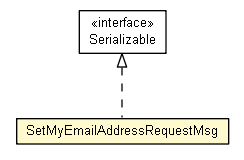
public class SetMyEmailAddressRequestMsg
extends Object
implements Serializable
Java class for SetMyEmailAddressRequestMsg complex type.
The following schema fragment specifies the expected content contained within this class.
 <complexType name="SetMyEmailAddressRequestMsg">
   <complexContent>
     <restriction base="{http://www.w3.org/2001/XMLSchema}anyType">
       <sequence>
         <element name="classification" type="{urn:org:miloss:fgsms:services:interfaces:common}SecurityWrapper"/>
         <element name="email" type="{http://www.w3.org/2001/XMLSchema}string" maxOccurs="4"/>
       </sequence>
     </restriction>
   </complexContent>
 </complexType>
| Modifier and Type | Field and Description |
|---|---|
protected SecurityWrapper |
classification |
protected List<String> |
email |
| Constructor and Description |
|---|
SetMyEmailAddressRequestMsg() |
| Modifier and Type | Method and Description |
|---|---|
SecurityWrapper |
getClassification()
Gets the value of the classification property.
|
List<String> |
getEmail()
Gets the value of the email property.
|
boolean |
isSetClassification() |
boolean |
isSetEmail() |
void |
setClassification(SecurityWrapper value)
Sets the value of the classification property.
|
void |
unsetEmail() |
protected SecurityWrapper classification
public SecurityWrapper getClassification()
SecurityWrapperpublic void setClassification(SecurityWrapper value)
value - allowed object is
SecurityWrapperpublic boolean isSetClassification()
public List<String> getEmail()
This accessor method returns a reference to the live list,
not a snapshot. Therefore any modification you make to the
returned list will be present inside the JAXB object.
This is why there is not a set method for the email property.
For example, to add a new item, do as follows:
getEmail().add(newItem);
Objects of the following type(s) are allowed in the list
String
public boolean isSetEmail()
public void unsetEmail()
Copyright © 2008–2017 MIL-OSS. All rights reserved.